
Take what is useful.
Two guides for after a difficult job, our own writing on noticing and asking, posters for your wall, and free guidance, films and podcasts from organisations that know this ground. Most of what is here is not ours, and that is deliberate.
After a difficult incident
Two guides of our own, written to be read on a screen, printed, or passed round a team. One is for anyone who was there. The other is for the person who has to look after everyone else, and who went through the same thing.
For the team
After a difficult job
What you might notice in the days and weeks after a difficult job, what helps, and when it is worth speaking to someone. Written for anyone who was there, on the radio, or picked it up afterwards.
- What you might notice
- What helps
- Look out for each other
- When to reach out for more
- Who you can talk to
For supervisors
After a difficult incident
Looking after your team, and yourself, in the weeks that follow. The first few hours, what to avoid, what to say when you are not sure what to say, and when someone needs more than peer support.
- The first few hours
- What to avoid
- The next four weeks
- Words that help
- Dark humour
- Looking after yourself
Both follow NICE guidance on what helps after a traumatic event, and what does not. Print and share them as they are rather than editing them, and tell us if something is missing for your service.
From us
- Look out for each other
What to notice, how to ask about suicide directly, and what to do if someone says yes.
- When someone says they are not doing great
What happens in the next two minutes matters more than any policy. Four things that help.
- Support lines by service
Police, fire, ambulance, armed forces and more, with the gaps named honestly.
Posters for your wall
Six posters, free to print and put up. A noticeboard, a control room, a canteen, a corridor, the back of a door. Each one carries the support lines at the foot, so anyone who stops to read one has somewhere to go in the same moment.
See the six posters and how to print them
Download all six · ZIP, 9.3 MB
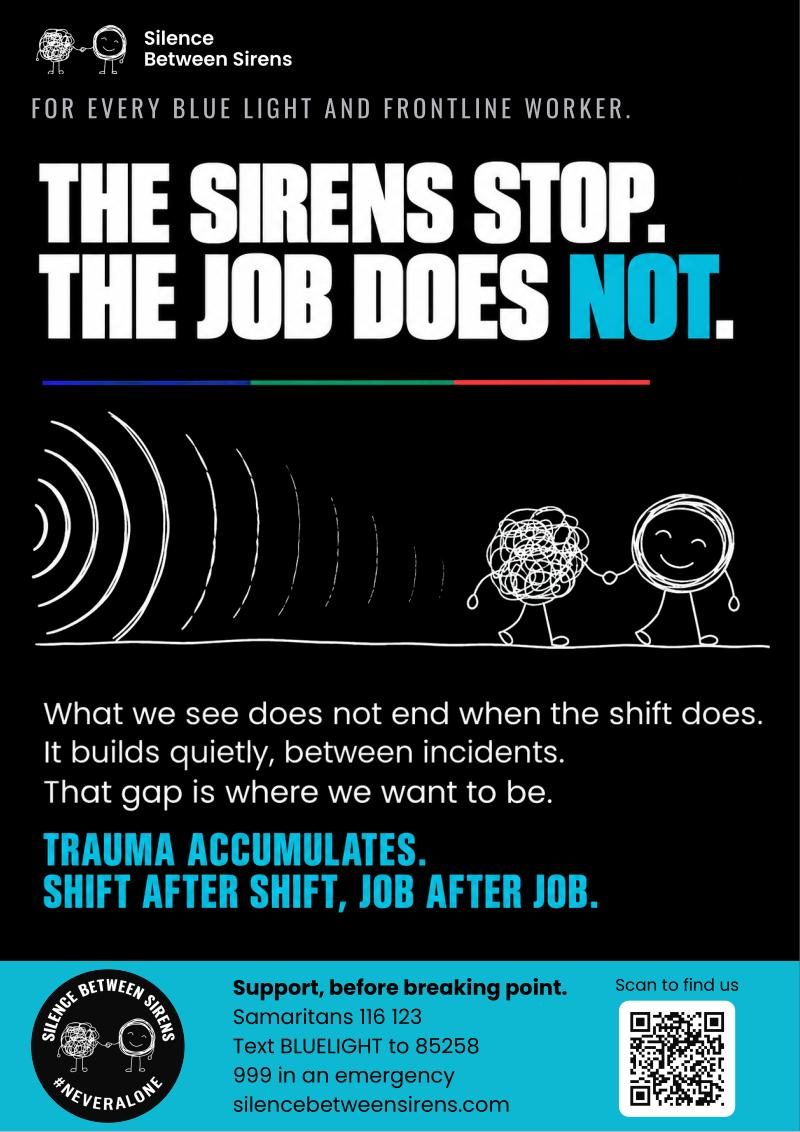
The sirens stop. The job does not.
What we see does not end when the shift does. It builds quietly, between incidents. That gap is where we want to be.
Download A2 PDF · 2.4 MB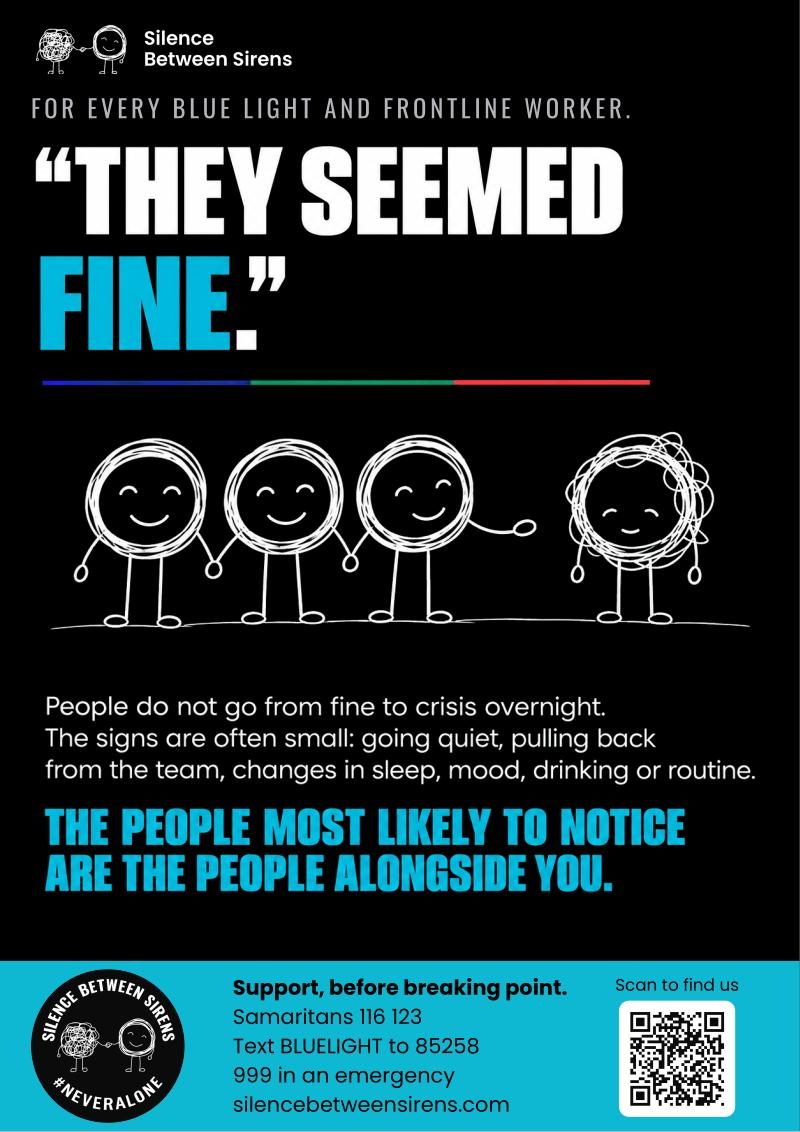
They seemed fine.
People do not go from fine to crisis overnight. The signs are small, and the people most likely to notice are the people alongside you.
Download A2 PDF · 1.5 MB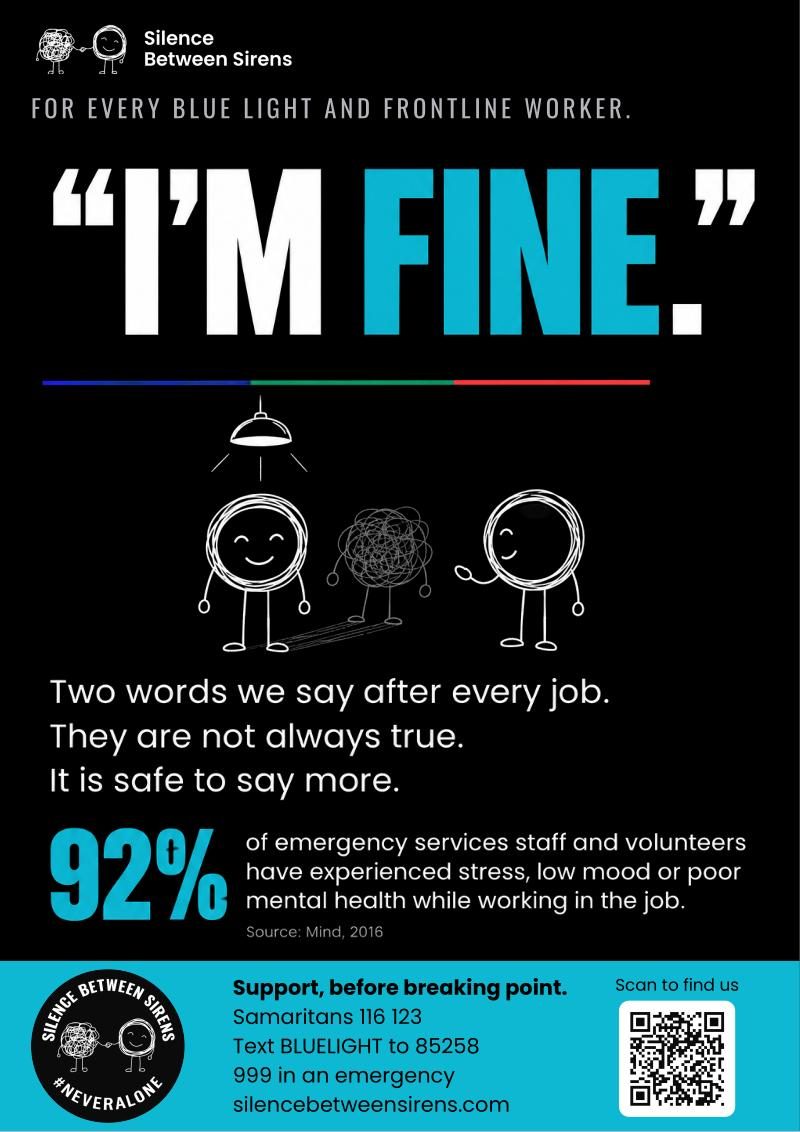
I'm fine.
Two words we say after every job. They are not always true. It is safe to say more.
Download A2 PDF · 0.8 MB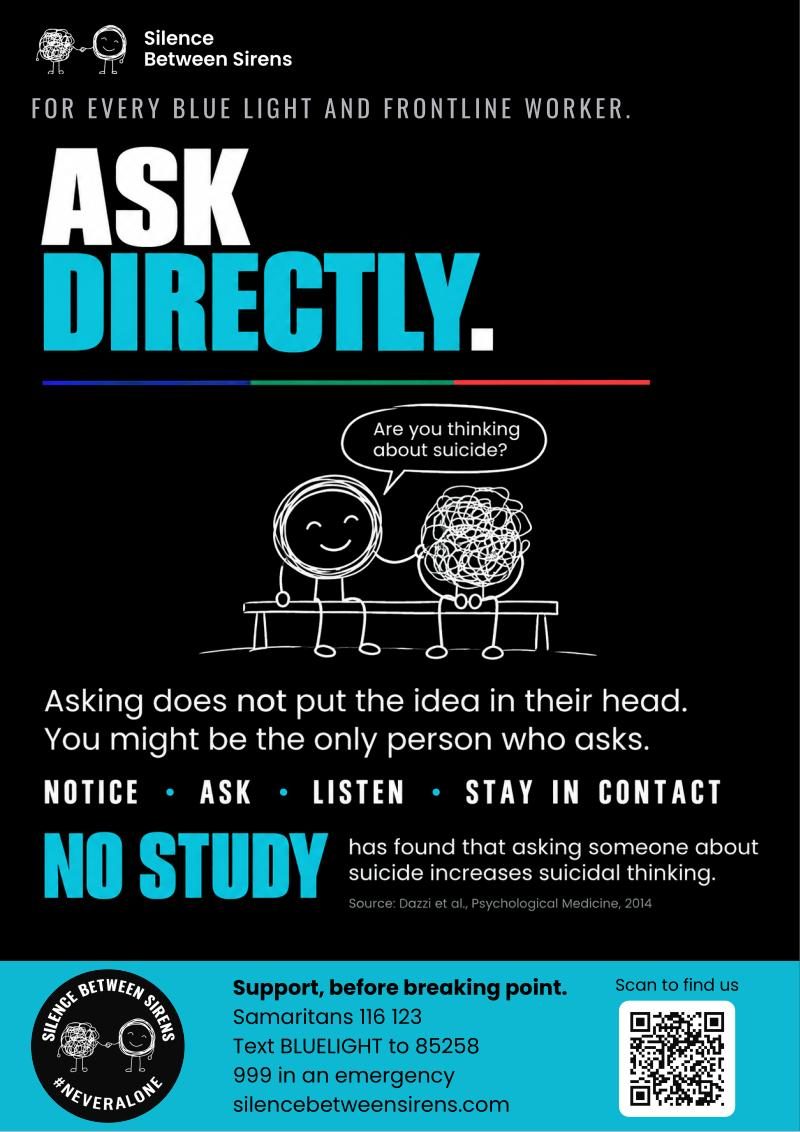
Ask directly.
Asking does not put the idea in anyone's head. You might be the only person who asks. Notice, ask, listen, stay in contact.
Download A2 PDF · 1.4 MB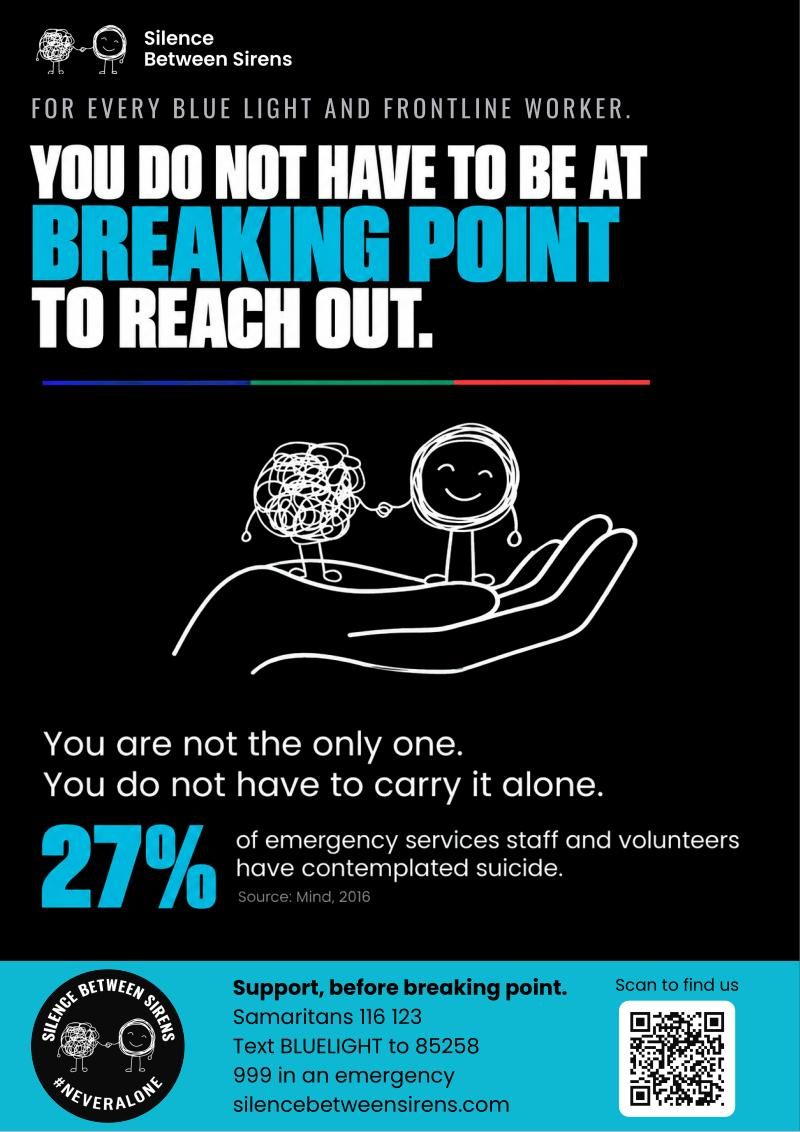
You do not have to be at breaking point to reach out.
You are not the only one. You do not have to carry it alone. Support is for long before crisis.
Download A2 PDF · 2.1 MB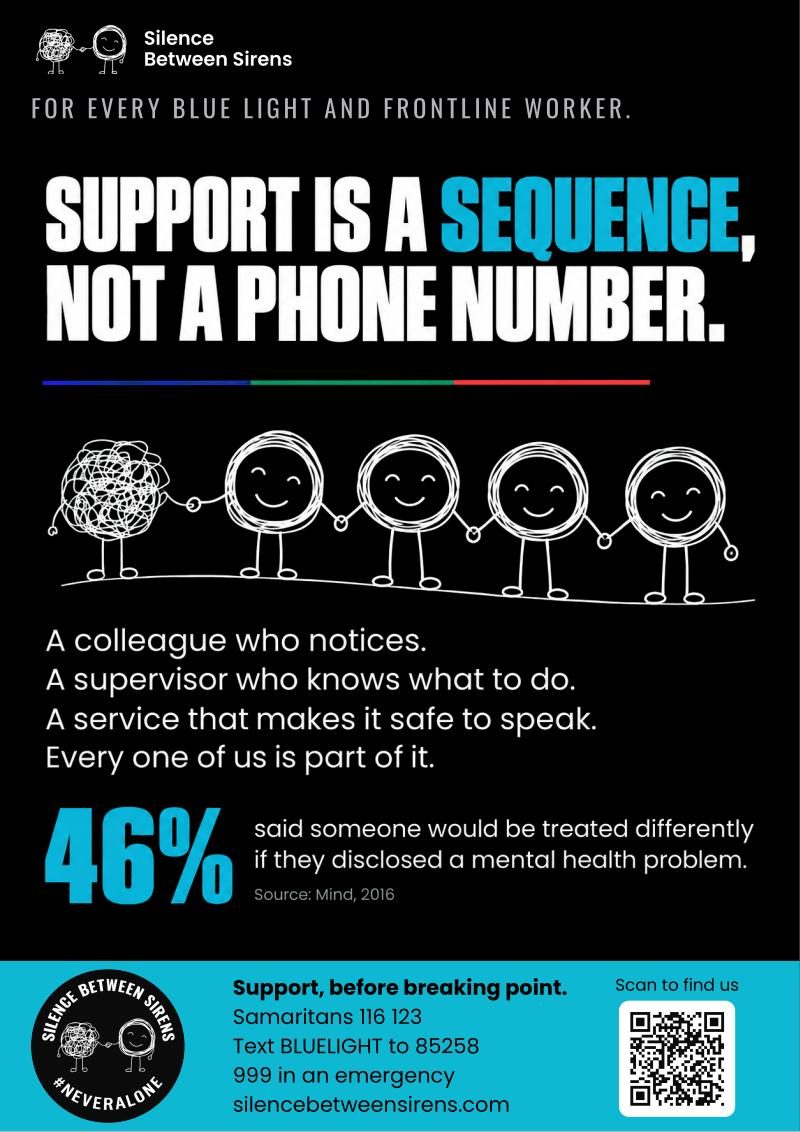
Support is a sequence, not a phone number.
A colleague who notices. A supervisor who knows what to do. A service that makes it safe to speak. Every one of us is part of it.
Download A2 PDF · 1.5 MB
How to print them, and where they work best
Printing
- They are made at A2. A2 and A3 both print cleanly. Below A3 the smaller text stops working across a room.
- Send the PDF to a print shop as it is. Nothing needs changing.
- They print on black, which takes a lot of ink. Above A4, a print shop usually works out cheaper than printing it where you are.
Where to put them
- Noticeboards, crew rooms, mess rooms, control rooms, canteens, locker rooms, corridors. Anywhere people pass or wait.
- Somewhere private matters as much as somewhere busy. The back of a toilet door or a quiet corridor lets someone read without being watched.
- Move them around every few months. A poster that has been up a year stops being seen.
Two asks
- Print and display them as they are, rather than editing them. The wording and the support lines have been checked against safe messaging guidance.
- Tell us where they go. We would like to know where they end up, and we are happy to talk about a version that sits alongside your own service's branding.
Read
Guidance, research and first-hand accounts. Start with the Samaritans page if you are not sure where to begin.
If you are worried about someone else
Samaritans
How to start the conversation when you think someone is not okay, how to listen, and what to do if they tell you they are having suicidal thoughts. The most practical starting point we know of, and written for people with no training.
Advice and support, by service
Lifelines Scotland, an NHS project
Written for ambulance, fire, police, prison service and volunteer responders, and organised the way it actually happens: understanding your response to trauma, how to know if you are not okay, whether stigma will stop you asking, and how to ask someone about suicidal thoughts. Scottish, and useful anywhere.
The Job, The Life, and what makes it worse
University of Cambridge, with Police Care UK
The research that found two in three police officers and staff with PTSD or complex PTSD symptoms did not know they had it, and the follow-up showing how much working conditions change the odds. Policing, though the pattern will be familiar across the services.
Blue Light Together
Blue Light Card Foundation
A hub built for emergency services staff, volunteers and their families, covering suicide prevention, family mental health and everyday resilience, with real stories alongside the guidance. It took over from Mind's Blue Light Programme.
Former police officers on the trauma they carried
BBC News
Three retired officers describe the slow accumulation, the years of quietly not being right, and the gap in support. The figures in it are on our sources page.
Watch
Training and films, free and open to anyone.
Free suicide awareness training
Zero Suicide Alliance
Free online training that takes you through spotting the signs, having the conversation and knowing where to point someone. Coached scenarios rather than a lecture. If you do one thing on this page, do this one.
Mental health awareness films
Oscar Kilo, the National Police Wellbeing Service
Short films and animations made for policing, meant to be watched alone or used with a team to start a conversation. Free to watch and free to use inside a service.
Listen
Podcasts from the charities that support each service. Useful on a drive home.
Keeping the Peace
Oscar Kilo, the National Police Wellbeing Service
Interviews with the people behind the National Police Wellbeing Service, on trauma support, shift work and fatigue, and what actually changes culture. Free, and wherever you get your podcasts.
Shout! Podcast
The Fire Fighters Charity
Health and wellbeing conversations and interviews with people the charity has supported, in their own words. Free to listen to.
TASC's official podcast
The Ambulance Staff Charity
The charity dedicated to the UK ambulance community, on the things that affect the people in it, including control room staff. Free to listen to.
Everything here is free and open to anyone. Links go to the organisation that made the resource, and we check them each quarter. If something here has stopped working, or you know of something that belongs on this page, tell us and we will look at it.
You do not have to be at breaking point to reach out.
Silence Between Sirens is not a crisis service. These lines are free and there for you now.